Self-Assembly Art
Self-Assembly refers to a spontaneous and reversible process by which a disordered system of pre-existing components organizes into structured, often intricate patterns - guided solely by local interactions among the components themselves, without external control. When the building blocks are molecular in nature, as in the interaction of pigments and solvents, the phenomenon is known as molecular self-assembly.
Self-Assembly Art is Eric's name for art made this way: art made by molecules organizing themselves. He works on a horizontal glass plate instead of an easel, introducing inks, pigments and solvents in a chosen order. Diffusion, surface tension and gravity then move the materials, and branches, cells and fronts emerge that no brush could plan.
Each composition exists only briefly. It is photographed at high resolution at a moment of dynamic equilibrium, then printed in the studio as a mixed-media work at the size the space calls for: a visual record of natural order arising from apparent chaos.
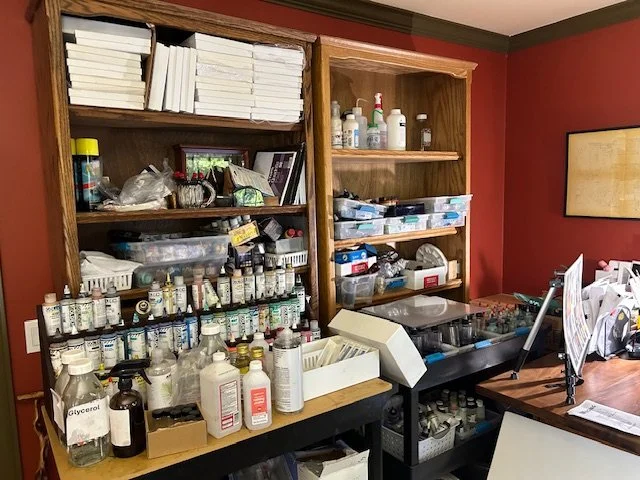
Self-assembly can be broadly categorized into static and dynamic types. In static self-assembly, an ordered structure emerges as the system approaches thermodynamic equilibrium, driven by a reduction in free energy. In contrast, dynamic self-assembly involves the formation of patterns from pre-existing components through specific local interactions. However, such dynamically evolving structures are often more accurately described as "self-organized" rather than "self-assembled," even though the two terms are frequently used interchangeably across disciplines.
The kinetics of self-assembly is typically governed by diffusion. The rate of adsorption or absorption often follows the Langmuir adsorption model, particularly in diffusion-limited regimes (e.g., dilute solutions). In such cases, the process can be approximated using Fick's laws of diffusion. Meanwhile, the desorption rate is influenced by the bond strength between surface molecules or atoms and is modulated by a thermal activation energy barrier. The overall growth rate of the assembled structure results from the competition between these adsorption and desorption processes.
Whitesides GM, Grzybowski B (March 2002). "Self-assembly at all scales". Science. 295 (5564): 2418–21.
Whitesides GM, Boncheva M (April 2002). "Beyond molecules: self-assembly of mesoscopic and macroscopic components". Proceedings of the National Academy of Sciences of the United States of America. 99 (8): 4769–74.
Damasceno PF, Engel M, Glotzer SC (July 2012). "Predictive self-assembly of polyhedra into complex structures". Science. 337 (6093): 453–7.
Feedback driven autonomous cycles of assembly and disassembly from minimal building blocks
Antara Reja, Sangam Jha, Ashley Sreejan, Sumit Pal, Subhajit Bal , Chetan Gadgil & Dibyendu Das
Nature Communications volume 15, Article number: 9980 (2024)